
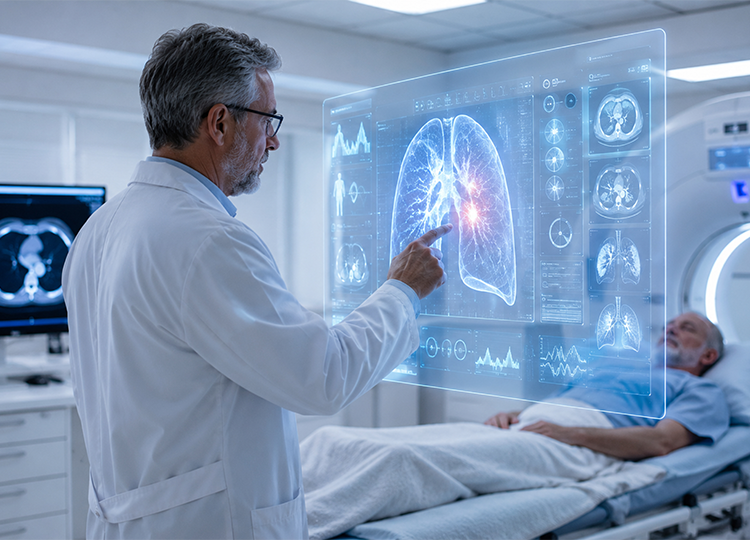
Key Takeaways:
- Healthcare AI consulting helps merge complex clinical data, reducing diagnostic errors and significantly improving overall patient outcomes across healthcare systems.
- Specialized healthcare AI consulting ensures seamless integration into existing workflows, preventing disruptions while maintaining strict compliance with clinical safety standards.
- Proper healthcare AI consulting incorporates human oversight, preventing automation bias and guaranteeing that licensed medical professionals make final diagnostic decisions
Diagnostic errors and the large amount of clinical data are serious problems for modern healthcare. Clinicians must manage large amounts of patient information, a cognitive load that may impair the speed and accuracy of diagnoses. This scenario is where the strategic role of healthcare AI consulting becomes critical to the transformation of diagnostic workflows.
Generic AI tools provide basic automation, while dedicated healthcare AI solution providers develop custom systems that cater to the complex realities of patient care.
AI can augment clinician expertise with specialized healthcare predictive analytics and sophisticated algorithms without adding complexity. Consulting-driven AI directly influences the accuracy of diagnoses, linking clinical practice and cutting-edge technology. Here is an in-depth look at 10 crucial ways consulting-led AI is reshaping diagnostic workflows across the care continuum.
10 Crucial Ways Healthcare AI Consulting Improves Patient Diagnosis
Healthcare AI consulting connects complex machine learning with practical clinical care. By designing and deploying tailored AI tools, these experts help medical systems and hospitals drastically reduce diagnostic errors, accelerate detection, and achieve better, earlier patient outcomes. Consulting-led AI reshapes diagnostic workflows across the care continuum by focusing on integration, precision, and clinical usability.
1. Multimodal Data Fusion for Context-Aware Diagnosis
Accuracy of diagnosis is rarely a single data point. AI consulting assists hospitals in implementing multimodal fusion, integrating electronic health records (EHR), medical imaging, lab results, and patient history into a unified, comprehensive view. This richer context leads to better diagnosis, especially in complicated or rare cases with overlapping symptoms.
2. Predictive Analytics for Early Disease Detection
The ultimate goal of proactive care is to identify risk patterns before symptoms clinically manifest. McKinsey’s findings reveal that applying predictive analytics and AI in clinical environments can greatly speed up early detection of diseases. (Source) Healthcare predictive analytics can help to identify micro-trends in patient data and take proactive measures that could change the course of diseases before they become critical.
3. AI-Driven Digital Pathology and Histology
Tissue analysis is very complicated and time-consuming. Using machine learning, digital pathology systems can scan and analyze tissue samples with remarkable accuracy in medical diagnosis. AI consultants also help laboratories deploy these models so they can quickly identify suspicious cellular structures, accelerating workflows and helping pathologists make their final determinations.
4. Edge AI for Rapid Diagnostics in Distributed Care Settings
Advanced diagnostics in remote clinics or ambulances require technology independent of heavy cloud computing. According to Gartner, most enterprises will soon process their data at the edge, outside traditional data centers. Healthcare Edge AI adopts this shift by enabling real-time processing on medical devices. (Source) This facilitates rapid diagnostics in distributed settings, reducing network dependency and providing immediate, life-saving insights at the point of care.
5. Medical Imaging Pixel-Level Analysis
Pixel-level analysis of medical images by AI models is revolutionizing radiology. They can detect micro-lesions, early-stage cancers, and abnormalities that are almost impossible to see with the naked human eye. AI consulting optimizes these advanced diagnostic tools for the specific imaging devices employed by the hospital.
6. AI-Enhanced Second Opinions
“Diagnostic uncertainty is a common occurrence in medicine. Forrester research shows that when organizations implement AI as an augmented intelligence tool, it significantly boosts professionals’ confidence in decision-making. (source) In healthcare, AI-augmented second opinions are a trusted safety net, cross-referencing clinician findings with massive amounts of medical data to reduce diagnostic errors and build clinical confidence.
7. Data Standardization and Bias Mitigation
The AI model is only as exceptional as the data it learns from. Healthcare AI solutions providers spend a lot of time cleaning, structuring, and standardizing disparate clinical data. More importantly, consultants have strict bias mitigation protocols to ensure that diagnostic outcomes are fair and equitable across patient demographics so historical biases do not skew AI outputs.
8. Seamless Integration into Clinical Workflows
Gartner identifies seamless operational integration as the top catalyst for AI success, while workflow disruption remains the biggest barrier to clinical adoption. (Source) To overcome these obstacles, healthcare AI consultants integrate tools directly into existing EHR platforms like Epic or Cerner. This allows clinicians to access advanced diagnostic capabilities within familiar interfaces, ensuring high adoption rates without additional software training.
9. Human-in-the-Loop Safeguards
Regulatory and ethical risk of total automation in medical diagnosis. “Human-in-the-loop” safeguards are needed for consulting-led implementations. This approach preserves strict clinician oversight by avoiding automation bias (users blindly accepting machine outputs) and ensuring that the final diagnostic decision is made by a licensed medical professional.
10. Smart Alert Calibration
Physicians are known for “alert fatigue” from overactive EHR systems. AI consulting teams tune and optimize intelligent alert systems to improve the signal-to-noise ratio. AI removes low-priority notifications and only highlights high-risk diagnostic indicators, allowing clinicians to focus their attention where it is needed most.
How Healthcare AI Solutions Providers Validate Diagnostic Models
For an AI model to be deployed in a clinical setting, it must be rigorously validated for patient safety and regulatory compliance. Leading healthcare AI providers validate their diagnostic models along several critical pathways:
- FDA & Regulatory Pathways to Clearance: Climbing the Software as a Medical Device (SaMD) ladder to get the needed approval for clinical deployment.
- Clinical Benchmarking: We benchmark the diagnostic accuracy of the AI against historical data and best-in-class human doctors.
- External Validation: Application of models across different healthcare settings and patient populations to assess the generalizability of the tool’s effectiveness.
- Explainability: Allow clinicians to understand the reasons for a particular diagnostic recommendation by providing them with transparent AI decision-making (Explainable AI or XAI).
- Bias and Fairness Testing: Ongoing tests to ensure algorithms are performing equally across different ethnicities, genders, and age groups.
- Ongoing Monitoring: Using tools to track “model drift” to ensure the AI remains accurate over time as clinical data and medical guidelines evolve.
Choosing the Right Healthcare AI Consulting Partner for Clinical Environments
Selecting the right partner is critical to moving AI projects from the pilot phase into scaled clinical reality. When evaluating healthcare AI consulting firms, look for the following criteria:
- Clinical Workflow Expertise: Deep understanding of how doctors and nurses actually work, not just technical prowess.
- Experience with EHR Integration: Proven ability to integrate natively with major systems like Epic, Cerner, and MEDITECH to streamline workflows, including leveraging AI clinical documentation to significantly reduce administrative burdens on healthcare providers.
- Regulatory Readiness: Strict adherence to HIPAA compliance, data security, and FDA regulatory frameworks.
- Proven Case Studies: Demonstrable success in deploying AI-driven diagnosis tools with measurable ROI and improved patient outcomes.
- Scalability and Time-to-Value: Frameworks that allow for rapid deployment and seamless scaling across multiple hospital departments.
- Post-Deployment Support: Commitment to ongoing model optimization, maintenance, and clinical user training.
Conclusion
Artificial intelligence is successfully bridging diagnostic gaps and elevating clinical decision-making across the medical field. However, this success rarely comes from off-the-shelf software; it depends entirely on consulting-led implementation, rigorous validation, and the establishment of clinical trust. The future of medical diagnosis is undoubtedly proactive, personalized, and data-driven.
To future-proof your clinical workflows and deliver the highest standard of patient care, it is time to take action. Partner with specialized healthcare AI solutions providers to build intelligent, seamless, and accurate diagnostic outcomes today.
FAQ
1. How can healthcare AI consulting be implemented without disrupting workflows?
Consultants achieve seamless implementation by conducting deep workflow analyses prior to deployment. By embedding AI insights directly into the existing EHR interfaces that clinicians already use, consultants eliminate the need for secondary applications and prevent workflow disruptions.
2. What should we look for in healthcare AI solution providers?
Prioritize providers with a strong track record of EHR integration, stringent HIPAA and FDA regulatory compliance, and a deep understanding of clinical workflows. Look for teams that offer explainable AI models and long-term post-deployment support to manage model drift.
3. How does machine learning in medical diagnosis improve outcomes?
Machine learning algorithms process massive volumes of complex medical data, such as high-resolution medical imaging and genomic profiles, at unprecedented speeds. This helps clinicians identify subtle abnormalities and micro-lesions earlier, leading to faster, more accurate diagnoses and timely treatment plans.
4. How does healthcare predictive analytics improve diagnostic accuracy?
Predictive analytics assesses historical and real-time patient data to identify hidden risk factors and early warning signs before severe symptoms occur. This allows clinicians to shift from reactive treatments to proactive, highly accurate diagnostic investigations, significantly improving overall patient outcomes.


Leave a Reply